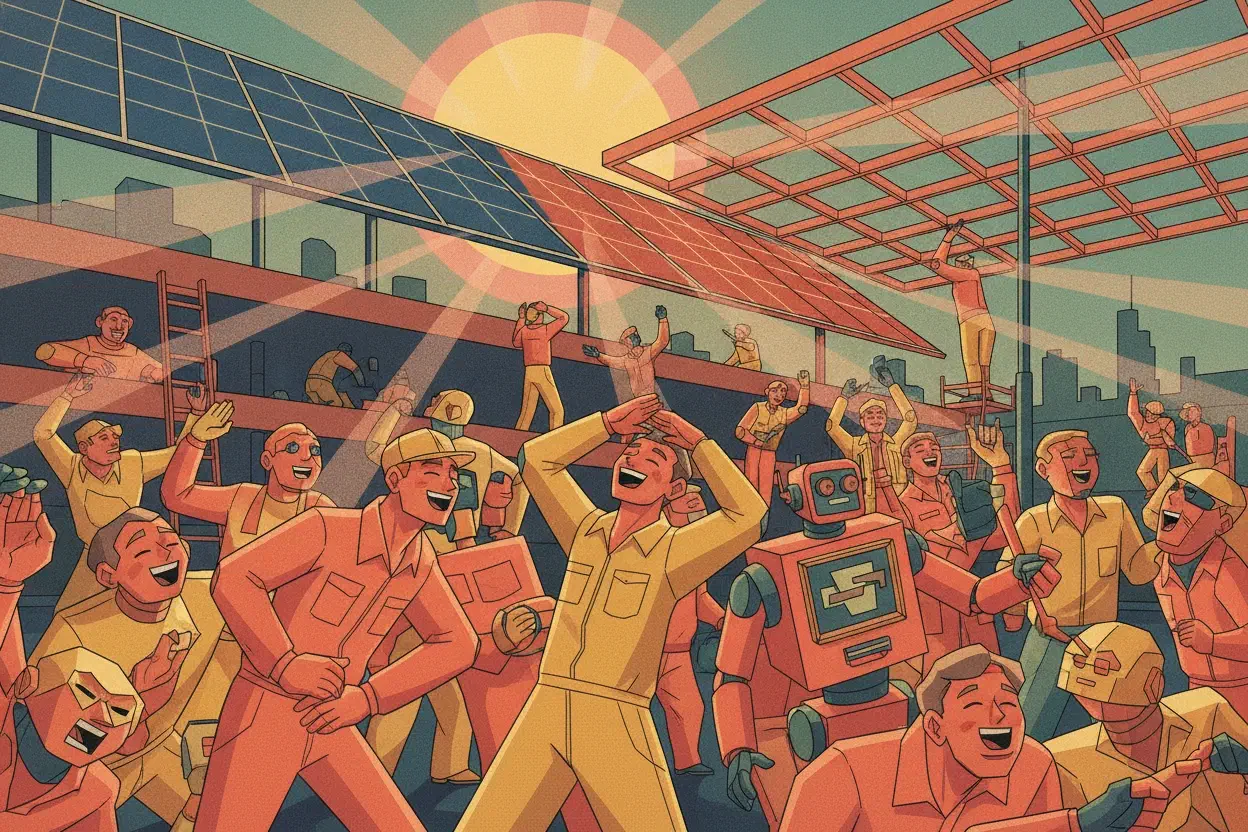
It was January 2018, my first week in Australia, and the thing I remember most clearly — more clearly even than the heat — was the light. After five Swedish winters I had been carrying around a small private hunger for it, and Melbourne handed it back on the very first afternoon, generously, almost extravagantly.
The blackouts started a few weeks later. 42°C, every air-conditioner in the suburb running at the same time, the grid trips, the lights go, and you stand in your kitchen in the dark in mild disbelief that one of the sunniest countries on Earth cannot keep its fridge cold. It happened the next summer too, and the one after that.
And one afternoon, mid-blackout, fan slowly spinning down, I remembered a carpark in Malmö. A small lot near the Turning Torso, in a country that gets a third less sun than Melbourne. The panels probably never made commercial sense — Sweden’s serious renewable energy lives elsewhere, in the onshore wind farms stitched across the south and the offshore turbines studding the Öresund — and the canopy is more useful for keeping the rain off your car than the lights on. Somebody had built it anyway. Eco-credentials, demonstration value, a small visible gesture in a district that wanted to look the part.
The maths
Meanwhile the maths in Melbourne is beautifully obvious. A Coles or a Woolies carpark, covered, would generate exactly when the grid is failing. Hot sunny days and air-conditioning peak are the same problem. Panels feeding the grid five metres from the load instead of three hundred kilometres from a paddock out west. Every shopping centre, every Bunnings, sitting bare and bright in the sun like an unanswered question. In eight years I have seen none of it built.
The accounting
The engineering is not the question. The accounting is. Malmö built its canopy without much of an engineering case because eco-credentials were legible to the local system. Melbourne will not build the same canopy with a far better engineering case because grid stability and proximity to load are not. Same physical object, different accounting, different outcome.
And the logic cuts both ways. Residential rooftop solar in Australia is the best in the world — per capita installations leave Germany, Japan, and yes Sweden far behind. The Small-scale Technology Certificate (STC) scheme made the suburban roof legible, and millions of panels followed. Same country, same engineering — wildly different outcomes on the rooftop and the carpark.
The pattern
Once you notice it, you notice it everywhere. Sweden burns rubbish in district heating plants and earns money importing other countries’ waste. Melbourne sends recycling to landfill and charges ratepayers for the privilege. Sweden’s pant deposit scheme returns over ninety per cent of beverage containers; Australia priced empty bottles at zero for decades and got bottles in the gutter.
Or insulation. The coldest I have ever been in my life — colder than any winter in Ukraine or Canada or Sweden — was indoors in Melbourne, in a rental, in a puffer jacket, watching my own breath. The local joke is that in a Melbourne winter it is colder inside than outside, and the joke is largely true. I mentioned insulation to a tradie once and he treated it the way you might treat a rumour about some unproven new technology, and could not quite believe me when I said people had lived in Norway on the strength of it for a few thousand years. The same wall that keeps a Stockholm flat warm in February would keep a Melbourne flat cool in February. The missing wall is the same missing wall as the missing carpark panel.
I am, honestly, grateful that I get to notice it at all. Multiple countries, one nervous system, a long slow accumulation of small comparisons — it is a kind of inheritance you only earn by staying somewhere long enough to forget it, and then leaving. I find this strangely freeing.